Can I add a battery to my existing solar panels?
Yes, in most cases. An AC-coupled battery can be fitted alongside your existing inverter without replacing it, or we can upgrade to a hybrid inverter with a DC-coupled battery. We assess your current system at survey, recommend the best approach, and provide a written quote. Adding a battery typically costs £3,500–£7,000 with 0% VAT applied until 31 March 2027.
Get a free quote
Tell us your postcode and we will be in touch.
Get a quote
Survey & design
Install & handover
What is the difference between AC-coupled and DC-coupled batteries?
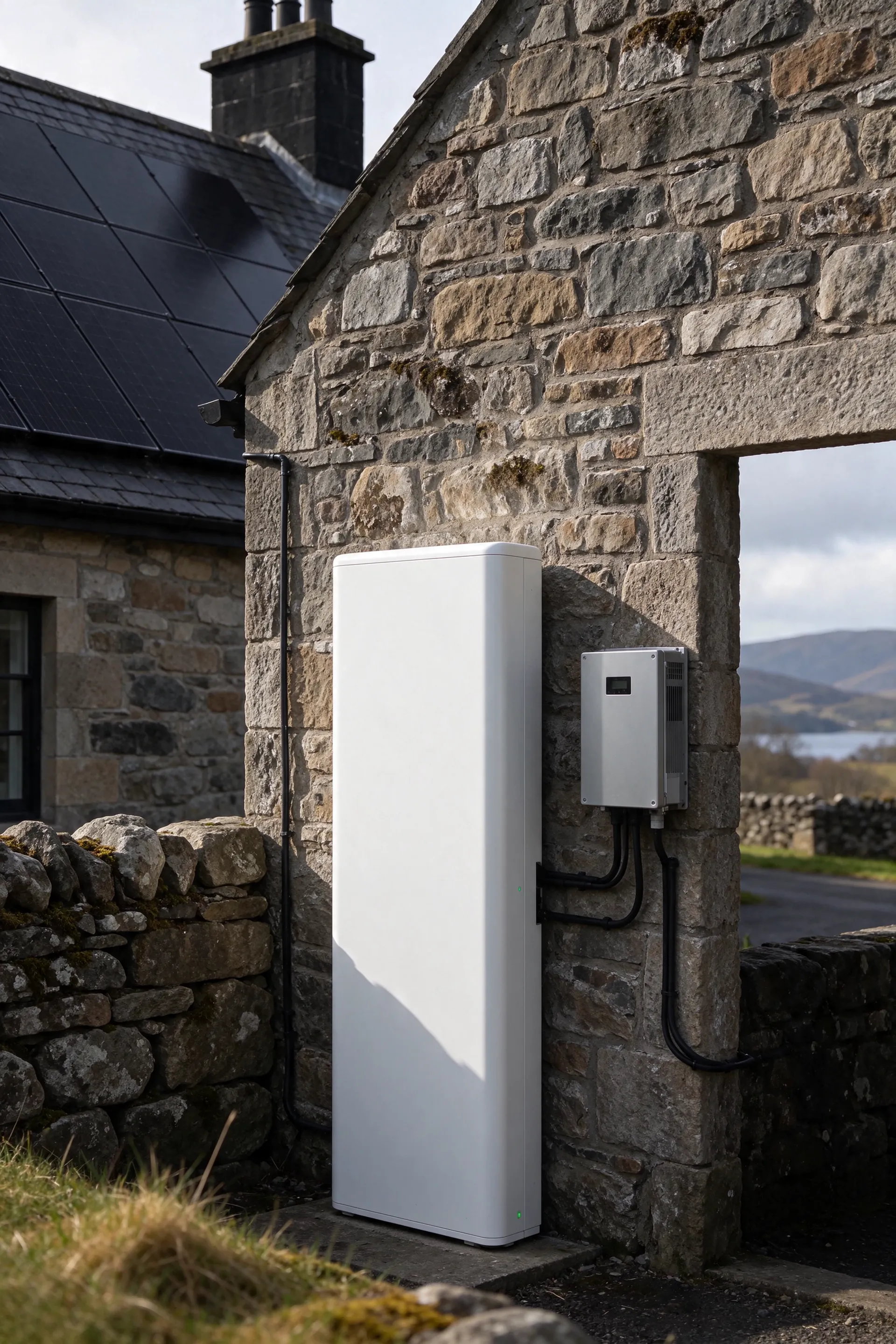
An AC-coupled battery connects to your existing solar system on the AC side, meaning it works alongside your current inverter without replacing it. This is usually the simplest and most cost-effective way to add storage to an existing array.
A DC-coupled battery connects on the DC side, meaning it pairs with a hybrid inverter that manages both solar generation and battery charging in one unit. This can be more efficient because the electricity only converts from DC to AC once, but it requires replacing your existing inverter with a hybrid model.
We assess your current system at survey and recommend whichever approach gives you the best outcome for your specific setup and budget.
How is a battery installed alongside existing panels?
The battery unit is mounted on a wall or floor in a garage, utility room, or loft — wherever is practical and close to your consumer unit and inverter. Cabling runs between the battery, the inverter, and your consumer unit. The installation typically takes one day and does not require any work on the roof or changes to your existing panels.
For AC-coupled systems, an AC-coupled battery charger is installed alongside the battery to manage charging from your solar surplus and discharging to your home. For DC-coupled systems, the hybrid inverter replaces your existing inverter and manages everything in one unit.
What size battery do I need for my existing panels?
The right battery size depends on your panel array size, your daytime consumption, and your evening usage. A 4–6kW panel system typically produces enough surplus to justify a 5–10kWh battery. A larger battery captures more surplus but costs more.
We model your generation and consumption at survey stage and recommend a battery capacity that matches your usage pattern. The goal is to size the battery so it is regularly charged and discharged, rather than oversized and sitting half-empty.
Will adding a battery reduce my electricity bills?
A battery stores the surplus electricity your panels generate during the day and lets you use it in the evening and overnight, which is when most households use most of their electricity. This reduces what you buy from the grid at peak times, which is when electricity is most expensive.
The exact saving depends on your tariff, your consumption pattern, and how much surplus your panels produce. We model this at survey stage so you can see the expected benefit for your specific situation before deciding.
What about finance for a battery-only installation?
Interest-free credit up to £30,000, subject to status, is available for battery-only installations as well as full solar and battery systems. This means you can spread the cost of adding a battery to your existing panels over monthly payments without interest charges.
There is 0% VAT on battery installations until 31 March 2027, which reduces the upfront cost. We confirm the finance terms and total cost as part of your written quote.
Looking for more answers? See more answers from Scottish Energy Efficiency.
What else do people ask?
Can I add a battery to my existing solar panels?
How much does it cost to add a battery to existing solar?
Will adding a battery work with my existing inverter?
How much electricity can a battery store from my existing panels?
Do I need to replace my solar panels to add a battery?
What should you read next?
Ready for a no-obligation quote?
Tell us your postcode and we will arrange a survey. Interest-free credit up to £30,000, subject to status.
Scottish-based team · MCS-certified installation partners · No-obligation quote